
Paleontology is the scientific study of past life. Paleontologists use fossils to piece together the history of Earth. Fossils are any evidence of past life—bones, teeth, shells, molds, casts, dinosaur tracks, worm burrows, gastroliths (stomach stones), petrified wood, leaves, and pollen.
Caves often contain two very different ages of fossils: those in the rock from which the cave formed, and younger fossils from animals that entered or washed in later. The fossils in cave rock reveal environments from hundreds of millions of years ago.
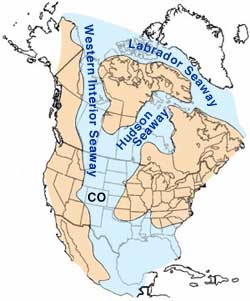
For example, during the Cretaceous Period, the Western Inland Seaway stretched from the Gulf to the Arctic, separating Eastern and Western North America. Central Texas limestone, evidence of this seaway, contains fossils of sea life, such as rudist bivalves (above)—clams that formed reefs. Sediments and shells accumulated on the ocean bottom and became rock.
Limestone, common in Central Texas, dissolves easily when carbon dioxide in rainwater forms weak acid, eroding the rock and forming caves. Some caves have surface entrances used by animals like opossums, snakes, birds, and bats. Predators such as cats and owls may drag prey inside, while rain can wash in remains. Because caves are stable environments with constant temperature and humidity, fossils inside are better preserved than on the surface.
The Pleistocene Epoch, or Ice Age, spanned from 2.58 million to 11,700 years ago, with many warm and cold intervals. Though ice sheets never reached Texas, Ice Age animals roamed here. The Edwards Plateau contains 19 Late Pleistocene sites, 18 of them caves. Most record the last glacial interval, between 20,000 and 11,700 years ago.
Friesenhahn Cave near San Antonio has yielded many remains of Homotherium (saber-toothed cat) and dozens of juvenile mammoth teeth, suggesting the cats used the cave as a den. Inner Space Cavern in Georgetown was discovered in 1963 during highway construction. Dr. Slaughter and Dr. Lundelius identified 44 animal species, including modern ones (bats, jaguar, white-tailed deer), those now absent from the area (black-tailed prairie dog), and extinct species (beautiful armadillo, Simpson’s glyptodont, Jefferson’s ground sloth, scimitar cat, mammoth, and a large extinct pronghorn).
Dr. John Moretti (below) later dated fossils from Inner Space, showing the site contains remains from about 47,000 to 9,500 years ago—older than any other Texas locality. These fossils reveal Texas’ natural history. For example, black-tailed prairie dogs once lived in Georgetown, but thinning soils over time drove them away. Questions remain, such as why white-tailed deer survived while many species went extinct at the end of the Ice Age.
Studies of these sites deepen our understanding of Earth’s history, past ecosystems, extinctions, and climate. As research continues, our view of the past evolves.
Further Resources:
- Ice Age Cave Faunas of North America (Indiana University Press)
- Mammoths by Adrian Lister and Paul Bahn
- First Peoples in a New World by David J. Meltzer
- Florida Museum of Natural History
- Texas Before History
Inner Space Cavern • One of the best preserved caves in Texas, Inner Space Cavern has hosted hundreds of thousands of visitors since 1966 and offers a variety of activities year round. InnerSpaceCavern.com • 4200 S IH-35 Georgetown