
From indigenous tribes brewing fermented beverages from local plants and grains to European heritage, to the creative focus of craft beers, beer has become a staple of Texas culture and commerce.
ONE LONG POUR
In the early days of European settlements, Spanish missionaries brewed most of the beer. As demand grew, so did the need for commercial breweries. Lone Star Brewery was established in 1884, followed by the Pearl and Spoetzl—a.k.a. Shiner—breweries, all of which played a significant role in the growth and development of the state’s economy.
When German, Polish, and Czech immigrants arrived in Texas, they settled in the Texas Hill Country, where the natural limestone springs matched the brewing conditions of their homeland. They introduced new lager techniques, old-world recipes, celebrations such as Oktoberfest, and biergartens— community spaces that welcomed families and hosted music and polka dances.
This strong European heritage made it possible for Texas’ beer industry to survive the competition of national breweries and the 1919 Prohibition law. Some of the breweries were able to remain open during Prohibition by introducing “near beer” with a lower alcohol content. Once Prohibition was repealed, breweries reopened and sprang back into business.
THE MODERN AGE
The modern American craft beer movement gained momentum in the 1970s, as small, independent brewers drew inspiration from European traditions and experimented with distinctive styles and flavors. Their creativity helped introduce drinkers to a broader appreciation of beer’s craftsmanship and variety.
In Texas, changes in state law helped that movement take root. The legalization of brewpubs in 1993 allowed brewers to make and sell beer directly to their customers. Twenty years later, another round of reforms expanded those opportunities: qualifying production breweries could sell beer for customers to enjoy in their taprooms, while brewpubs gained the right to distribute beyond their own premises. Together, these changes opened new paths for small businesses to reach beer lovers across the state.
The results represent a substantial contribution to the Texas economy. According to the Texas Craft Brewers Guild’s 2025 figures, the state had 420 craft breweries, ranking sixth nationally. The industry supported more than 23,000 jobs and generated approximately $4.6 billion in economic impact—the third-highest total in the country.
A spirit of collaboration runs through the business, with brewers sharing knowledge, resources, and ideas that help strengthen the wider craft beer community. That combination of craftsmanship and entrepreneurship has also found a place in the classroom. At The University of Texas at Dallas, a graduate course examines the craft brewing business from financing and production to marketing, distribution, and regulation, giving students a practical look at what it takes to turn a passion for beer into a livelihood.
WHICH BREW IS FOR YOU?
Almost every beer belongs to either the ale or the lager category.
Ales are top-fermented. The yeast rises to the top of the liquid after fermenting at warmer temperatures. This produces bold, complex, fruity, and spicy flavors.
Lagers are bottom-fermented. Cooler temperatures cause the yeast to settle to the bottom, followed by a cold conditioning period. They are known for their clean, crisp flavors and smooth finish.
RAISE A GLASS!
Alongside the big, nationally recognized brands like Anheuser-Busch, Miller, Coors, and Modelo, craft brands have gained prominence, as they celebrate the combination of Texas traditions with modern innovation:
- Spoetzl Brewery in Shiner is the largest Texas craft brewery, and Shiner Bock—a dark amber lager—is the most famous and widely distributed brand.
- Lone Star Beer in San Antonio, a classic-style lager, is known as “The National Beer of Texas.”
- Pinthouse Brewery’s Electric Jellyfish from Austin and Yellow Rose from Lone Pint Brewery in Magnolia, both IPAs, are consistently top-rated.
- Houston’s Saint Arnold Brewing Company’s crisp German Style Fancy Lawnmower is a classic favorite.
- 512 Brewery in Austin features its dark, rich Pecan Porter, using locally grown Texas pecans.
A THIRST FOR COMMUNITY
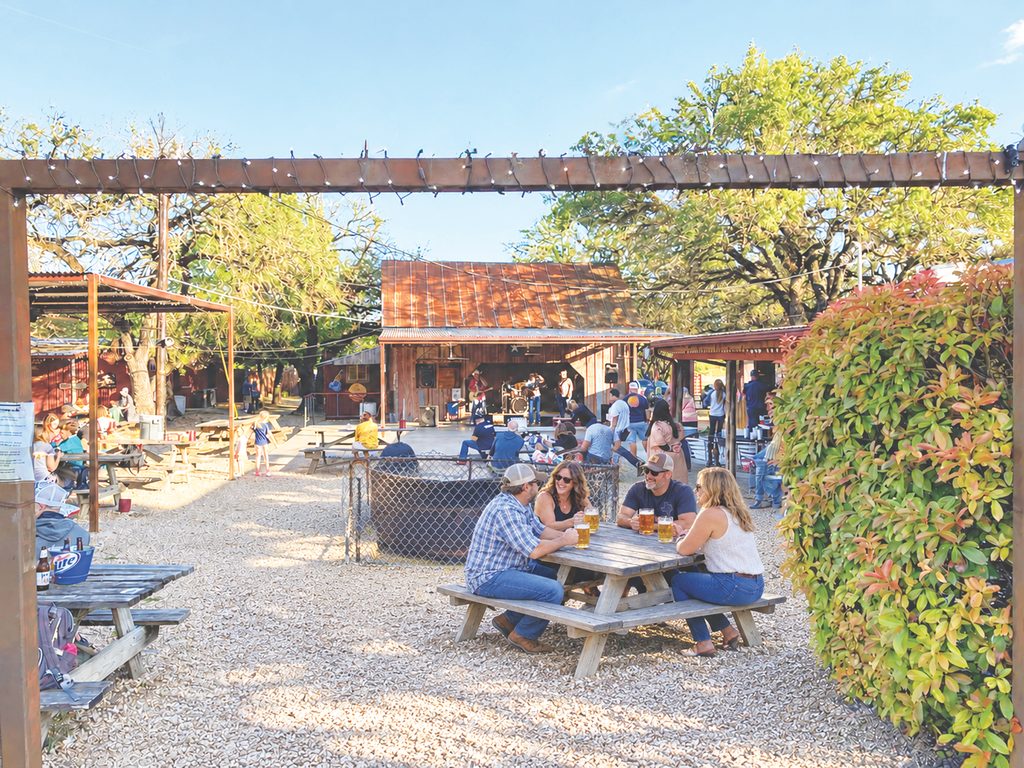
Dimly lit dive bars with their sticky floors have been reinvented into sunlit community spaces. A modern twist on the European beer garden, these social hubs have become our modern town squares.
Large patios and open lawns provide ample space for children and dogs. Play areas and games offer a friendly atmosphere. On-site food trucks, restaurants, and weekend afternoon events allow for adult socializing that welcomes families.